December 12
Gustave Flaubert
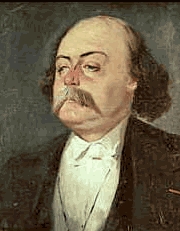
On this date in 1821, novelist Gustave Flaubert was born in Rouen, France. Destined by his family for medicine, Flaubert preferred the world of literature. He traveled widely for nearly two years and ascended to the top of the Great Pyramid in Egypt. After trying his hand at poetry, Flaubert became a novelist. His classic, Madame Bovary, which took him five years to write, was published in 1857. Its realistic portrayal of adultery offended religious sensibilities. Flaubert was criminally prosecuted but escaped conviction.
His friends and correspondents included many leading skeptical literati of his day, including Zola, George Sand and Turgenev. Flaubert wrote four other novels, including Salammbo (1862) and The Temptation of Saint Antoine (1874), which reveals some of his skepticism, a book of short stories and a play. He is widely quoted as saying, “It is necessary to sleep upon the pillow of doubt.”
He was a pantheist and devotee of Spinoza. He never married and suffered from epilepsy and veneral diseases, dying of a cerebral hemorrhage at age 58. He died in Rouen, a city on the River Seine where he was born. (D. 1880)
“And I can’t admit of an old boy God who takes walks in his garden with a cane in his hand, who lodges his friends in the belly of whales, dies uttering a cry, and rises again after three days; things absurd in themselves, and completely opposed, moreover, to all physical laws, which proves to us, by the way, that priests have always wallowed in squalid ignorance, and tried to drag whole nations down after them.”
— Pharmacist in Flaubert's "Madame Bovary" (1857)
Compiled by Annie Laurie Gaylor
© Freedom From Religion Foundation. All rights reserved.
Jay Gorney
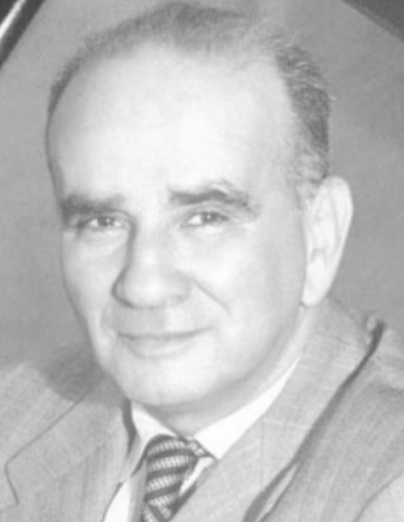
On this date in 1894, songwriter Jay Gorney (né Abraham Jacob Gornetzsky) was born in Bialystok, Russia (now part of Poland). His family emigrated to the U.S. when he was 9, settling in Detroit. He graduated from the University of Michigan Law School in 1917 but practiced law only briefly before moving to New York City to write songs on Tin Pan Alley.
The composer of “Brother, Can You Spare a Dime?” was a nonbeliever who ended up being blacklisted for his liberal views. He discovered Shirley Temple, for whom he wrote her first movie song “Baby, Take a Bow” (in “Stand Up and Cheer”). He wrote such standards as “You’re My Thrill” and “What Wouldn’t I Do for That Man?” plus hundreds of popular songs for theater, film and television. “We were not a religious family,” his widow Sondra Karyl Gorney said in a telephone interview. She wrote the 2005 biography Brother, Can You Spare a Dime? The Life of Composer Jay Gorney.
Gorney had a son with his first wife, Edelaine Roden, and two children with Sondra, whom he married in 1943 before a justice of the peace. Earlier that year, his first wife had married his collaborator, lyricist Yip Harburg.
He died of Parkinson’s at age 93 at the Jewish Home and Hospital for the Aged in Manhattan, with a memorial held at the New York Public Shakespeare Theater. (D. 1990)
Congress shall make no law respecting the establishment of religion,
Or prohibiting the free exercise thereof,
Or abridging the freedom of speech
Or of the press
Or the right of the people peaceably to assemble
And to petition the government for a redress of grievances —
That’s the Bill of Rights.
Don’t lose it!— A verse Gorney sang during his 1952 testimony before the House Un-American Activities Committee, "Brother Can You Spare a Dime?" by Sandra K. Gorney (2005)
Compiled by Annie Laurie Gaylor
© Freedom From Religion Foundation. All rights reserved.
Frank Sinatra (Quotes)
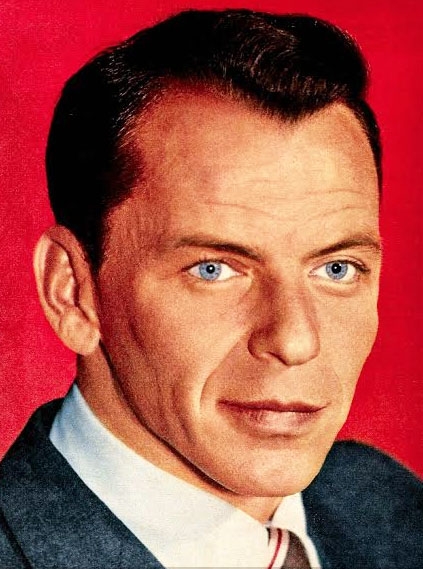
“There are things about organized religion which I resent. Christ is revered as the Prince of Peace, but more blood has been shed in His name than any other figure in history. You show me one step forward in the name of religion and I’ll show you a hundred retrogressions. Remember, they were men of God who destroyed the educational treasures at Alexandria, who perpetrated the Inquisition in Spain, who burned the witches at Salem.* Over 25,000 organized religions flourish on this planet, but the followers of each think all the others are miserably misguided and probably evil as well. In India they worship white cows, monkeys and a dip in the Ganges. The Moslems accept slavery and prepare for Allah, who promises wine and revirginated women. And witch doctors aren’t just in Africa. If you look in the L.A. papers of a Sunday morning, you’ll see the local variety advertising their wares like suits with two pairs of pants.”
“As I see it, man is a product of his conditioning, and the social forces which mold his morality and conduct — including racial prejudice — are influenced more by material things like food and economic necessities than by the fear and awe and bigotry generated by the high priests of commercialized superstition. Now don’t get me wrong. I’m for decency — period. I’m for anything and everything that bodes love and consideration for my fellow man. But when lip service to some mysterious deity permits bestiality on Wednesday and absolution on Sunday — cash me out.”
— Sinatra, born on this date in 1915. (Interview, Playboy magazine, February 1963)
*EDITOR’S NOTE: There is no evidence that alleged witches were burned in North America. That did happen in Europe, however. Sinatra’s claims about more people being killed in Jesus’ name is also unsubstantiated, although certainly millions have been. Likewise, it’s not been demonstrated that Muslims supported slavery more than Christians or some other religions.
—
Compiled by Bill Dunn
© Freedom From Religion Foundation. All rights reserved.
Bill Nighy
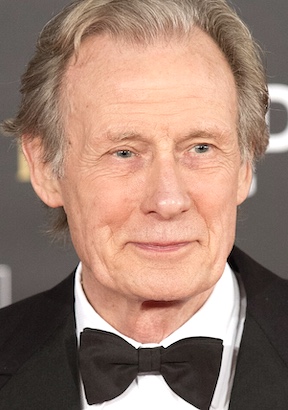
On this day in 1949, actor William Francis Nighy was born in Caterham, Surrey, England, to Catherine (née Whittaker) and Alfred Nighy. His mother was a psychiatric nurse of Irish descent and his father managed a vehicle repair shop after working in the family chimney sweeping business.
His maternal grandmother “kind of raised me,” says Nighy (pronounced Nye, rhymes with guy), who has a brother and a sister. “She was a proper Irish woman, a Catholic. I was to be a priest. That was the hope. I was the last hope, because I was the youngest. I was a likely candidate until I got to be about 15 or 16. I used to serve Mass three or four times a week.” (The Irish Times, Nov. 2, 2024)
He attended a Catholic grammar school where he was shy and sought refuge in books before leaving school at age 15. “I was a terrific Catholic until I started worrying about my hair and other related subjects.” (Interview on Zavvi.com, April 2, 2024)
F. Scott Fitzgerald and Ernest Hemingway were among his favorite authors. He ran away from home twice, failed at writing a novel and after a period of wanderlust worked at magazines before enrolling at the Guildford School of Dance and Drama.
Nighy’s acting chops eventually landed him television appearances and numerous stage roles in the 1970s and ’80s, most notably in National Theatre productions alongside Anthony Hopkins and Judith Dench. To say he has had acting success, with 184 screen and stage credits as of this writing in 2025, is an understatement.
He explains: “I had a job most of the time. It was 10 years, I think, before I was in front of a camera. … But I didn’t make any serious money for a long time. Eventually, I made it on to the telly. I suppose that was during the 1980s. But it was hand-to-mouth for a while.” (Ibid., The Irish Times)
Starting in 1982, Nighy was in a relationship with English actress Diana Quick. They both had roles in playwright David Hare’s “A Map of The World.” They had a daughter, actress and filmmaker Mary Nighy, in 1984 before amicably separating after 27 years in 2008.
The Internet Movie Database describes his trademarks as his gaunt, pale appearance and offbeat characters. He has appeared in such noteworthy films as “Love Actually” (2003), “Shaun of the Dead” (2004), “The Hitchhiker’s Guide to the Galaxy” and “The Constant Gardener” (2005), “Pirates of the Caribbean: Dead Man’s Chest” and “Underworld: Evolution” (2006), “Harry Potter and the Deathly Hallows – Part 1” (2010), “Wrath of the Titans” (2012), “The Second Best Exotic Marigold Hotel” (2015), and “The First Omen” (2024), a horror film in which he plays a Catholic cardinal.
He has received numerous accolades, including a British Academy Film Award, a British Academy Television Award and a Golden Globe Award as well as nominations for an Academy Award, two Screen Actors Guild Awards, a Laurence Olivier Award and a Tony Award.
The movie he’s most proud of is “Pride” (2014). Set in London and rural Wales during the miners’ strike of 1984–85, it details an unlikely alliance between the union and a group of lesbian and gay activists who are attacked by Prime Minister Margaret Thatcher and her Conservative Party allies. Nighy plays a closeted union leader.
Thatcher proclaimed at a Conservative Party conference that “children who need to be taught to respect traditional moral values are being taught that they have an inalienable right to be gay. All of those children are being cheated of a sound start in life.” (SBS Australia, Feb. 26, 2019)
“I’ve lived through a time when gay men and women were perceived, by a large part of society, as nauseating,” countered Nighy, remembering arrests of gay teens in his youth. “There was no legislation to protect them, and I find the progress that has been made since intensely moving. ‘Pride’ celebrates that fact so sweetly in this brilliant, absolutely true story. It was a wonderful thing.”
PHOTO: Nighy at the 2018 Goya Awards in Madrid, Spain; photo by Carlos Delgado under CC-BY-SA.
“I worked very hard to not be a Catholic. Still, I’m perfectly cheerful about the prospect of there being something [after life], but I have no information in that area. I’ve never had contact with the supernatural.”
— Nighy recalling how he kept waiting for a call from God that never arrived. (The Sunday Times, Feb. 18, 2023)
Compiled by Bill Dunn
© Freedom From Religion Foundation. All rights reserved.